
Why High-Risk Merchants Are Migrating to Self-Custodial XRPL Checkouts
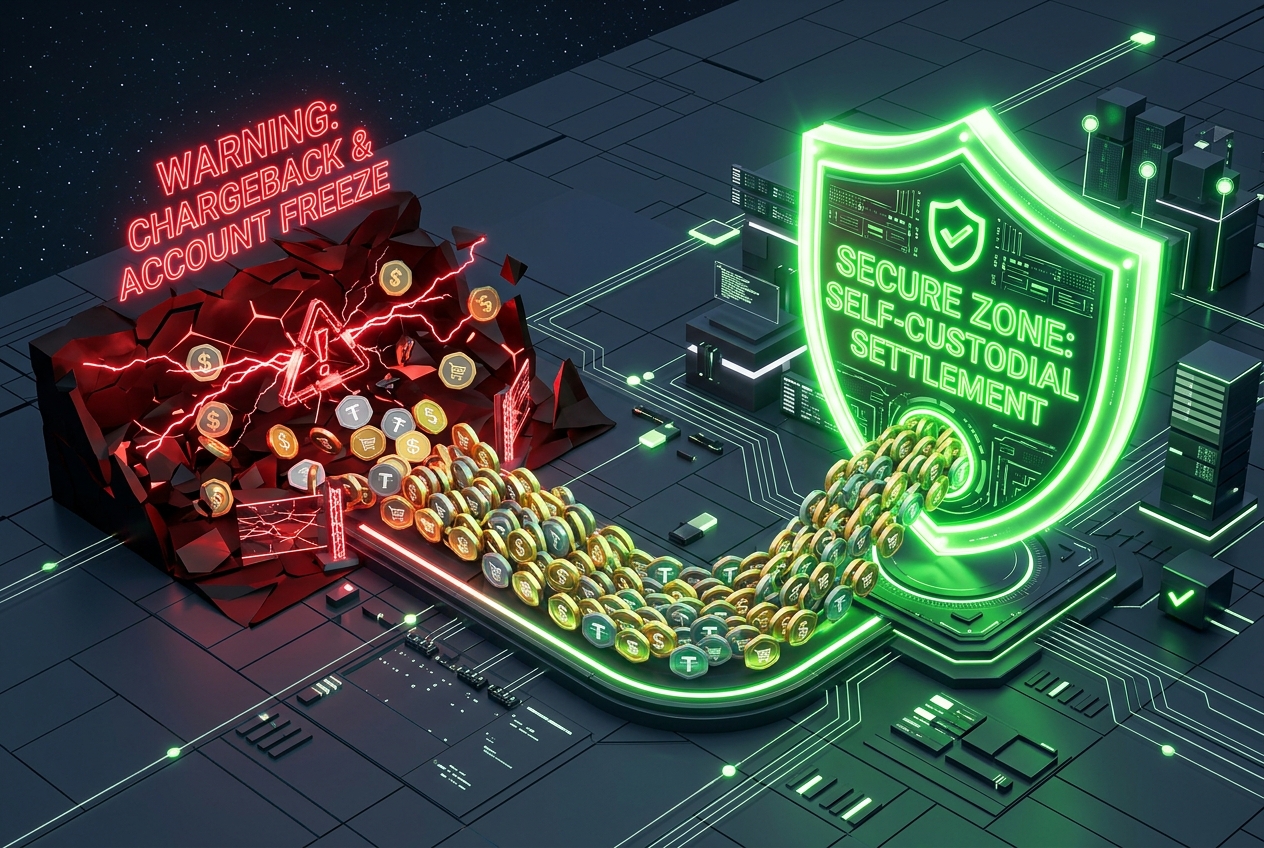
For e-commerce businesses operating in industries labeled as "high-risk," securing stable credit card processing is an ongoing operational battle.
Traditional merchant processors impose heavy financial penalties, including high transaction fees (often scaling to 5%-8%), rolling reserves that lock away 10% of gross revenue for up to 180 days, and sudden account freezes without warning.
By moving from pull-based card networks to push-based cryptographic ledger checkouts, merchants eliminate chargeback fraud and rolling reserves entirely.
1. Credit Card Processing vs. Self-Custodial Settlement
Traditional card networks are built on a pull-based payment model: the merchant requests funds from the buyer's credit card, and the cardholder can dispute the transaction up to 120 days later. This system places the risk entirely on the merchant.
In contrast, the XRP Ledger is a push-based, peer-to-peer consensus network: payments are authorized directly by the holder of the private key, and once written to the block, they are mathematically irreversible.
| Operational Risk | Traditional Processors | Self-Custodial XRPL |
|---|---|---|
| Chargeback Fraud | High (120-day dispute window) | Zero (Irreversible consensus) |
| Rolling Reserves | Yes (10% locked for 180 days) | No (100% instantly available) |
| Account Freezes | Common (Unilateral decision) | Impossible (Non-custodial keys) |
| Processing Fees | 4.5% - 8.5% + transaction fees | 0.5% flat gateway fee |
| Settlement Time | 3 - 7 business days | 3 - 5 seconds finality |
2. Eliminating the Custodial Middleman
Many merchants who initially turned to crypto payment gateways to avoid credit card fees found themselves facing similar risks with custodial crypto gateways. If your crypto gateway holds your funds in their omnibus corporate accounts before paying you out, they still have the power to freeze your account, demand extensive documentation, or delay your payouts.
By utilizing a 100% self-custodial gateway like XRPay, the payment flows directly from the buyer’s wallet to your own private keys. XRPay’s backend API merely monitors the ledger to update your order status; at no point does XRPay have the physical ability to touch, hold, or freeze your funds.
3. How XRPay Optimizes XRPL Checkout
Transitioning to crypto can sometimes introduce customer friction. XRPay minimizes this friction by providing:
- Multi-Asset Payment Support: Customers can pay with Bitcoin, Ethereum, stablecoins, or XRP. The system handles conversion under the hood.
- Stablecoin Settlement: Volatility is bypassed by settling directly in fiat-backed tokens (RLUSD or USDC).
- Automated Bank Payouts: Using verified off-ramp APIs, stablecoins are swept directly to the merchant's business bank account.
4. The Economic Impact: A Scenario Analysis
Consider a high-risk SaaS merchant processing $100,000 USD in monthly transactions:
Under a Traditional High-Risk Processor:
- Processing Fees (6%): -$6,000
- Rolling Reserve (10% locked for 180 days): -$10,000 (Unavailable working capital)
- Chargeback Fraud & Dispute Fees (1.5% rate): -$1,500 + $500 in fees
- Actual Net Monthly Cash Flow: $82,000 (with $10,000 locked for 6 months)
Under XRPay (XRPL Self-Custodial):
- Gateway Fees (0.5%): -$500
- Rolling Reserve (0%): $0 (100% of cash flow available immediately)
- Chargeback Fraud (0%): $0 (Irreversible settlements)
- Actual Net Monthly Cash Flow: $99,500 (all cash available instantly)
By switching to self-custodial ledger settlements, the merchant increases their monthly cash flow by $17,500 while unlocking their capital reserves.